

Development and Emergence

Updated: Jul 24
Two Distinctly Different Logics of Change
What prompted it is something I keep running into in organisational life: development and emergence being treated as if they described the same kind of change. They don’t. They are structurally different processes with different governing logics, and conflating them produces interventions that systematically address the wrong thing. The cost is a misdirection at the level of design. The article begins by getting that distinction right, because what follows depends on it.
Different Kinds of Processes
It helps to start with a third kind of process, one that most people find immediately legible, before moving to the harder distinction. Consider construction. When a bridge is built, the logic is clear: there is a design, there are components, and the task is to assemble them correctly. The parts do not transform through the process. A steel beam remains a steel beam. Agency is external: someone drew the plans, someone is directing the build. Nothing emerges that was not already specified. Nothing develops in the sense of integrating new capacities. Dave Snowden’s Cynefin framework places this in the complicated domain: difficult, requiring expertise, but ultimately engineerable. There are right answers, and trained people can find them.
Developmental change has a different shape. Think of a human being growing from embryo to infant to adolescent to adult: Each phase builds on the previous one. This is not just growth in size or complexity. It is integration: capacities that were once external — language, abstract thinking, the ability to take another person’s perspective — become genuinely part of the person over time. There are recognisable stages in this process, and development does not stop at adulthood. Adults continue to develop in how they handle complexity, relate to their own assumptions, and take the perspectives of others. How adults continue to develop, and whether that development follows universal stages, is a separate argument that this article will return to. What makes all of this developmental, at any age, is continuity: there is a subject, a locus, a centre from which the process is driven — even if that centre is itself transformed along the way.
Emergence has a different shape again. Watch a wasp colony build its nest. No wasp holds the blueprint, and no individual, not even the queen, directs the others. The hexagonal cells, the layered structure, the allocation of roles across the colony — none of this is located in any single wasp or group of wasps. It arises from local interactions: chemical signals, proximity, threshold responses to what neighbouring wasps are doing. The pattern is real and extraordinarily complex, but its organising principle is not inside any of its members. It is a property of the interactions themselves. The same is true of a mycelial network, which routes nutrients across a forest floor, connects the root systems of separate trees, and responds to obstacles — all without any coordinating centre.

The philosopher Alicia Juarrero describes this kind of process in terms of context-sensitive causation: higher-level conditions constrain lower-level interactions in ways that open a space of possible configurations, without any single agent specifying what those configurations will be. The wasp colony does not develop toward its form. It explores a space of possibilities made available by its constraints — through a process that is different in kind, not just in degree, from development.
Bonnitta Roy’s generative process typology maps this out (here, very simplified).
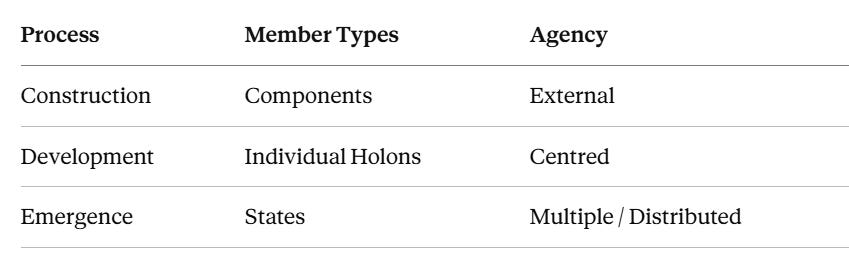
Three different kinds of change — not different speeds or scales of the same thing, but different in kind. This table is not a ranking, and emergence is not a higher form of development. They are different processes with different logics, and both occur in real organisations. The question is which one you are actually dealing with — and whether your intervention logic matches.
Application
Applying the wrong logic to the wrong phenomenon has predictable costs. Organisations invest in leadership development programmes expecting cultural transformation and most often get better-trained individuals who return to an unchanged field. They diagnose a team’s difficulties as a skills gap or a developmental problem — people somehow not yet mature enough in their thinking — when the actual obstacle may be a property of the field: the incentive structures, the informal hierarchies, the patterns of interaction that individual development alone will not shift. They apply frameworks that rank people and teams on a developmental hierarchy, which alters the relational dynamics in ways that actively work against the emergence they were hoping to support. And the conditions that would actually make a difference — the constraint changes, the shifts in who has voice, the alterations to what is safe to say — never get attended to, because the intervention logic is looking somewhere else entirely.
Development and developmental stage theory
The distinction between development as a generative process and developmental stage theory matters, and it deserves direct attention. Stage theory makes an additional claim beyond the observation that development happens: that it follows a universal sequence of hierarchical levels, and that higher levels represent more mature, more capable, more fully developed human beings. That additional claim is not required by the observation that development occurs. It is a separate argument — about universality, hierarchy, and adequacy — and it is the argument the second part of this article examines. What matters here is the assumption the two share: that the framework applies to individuals, and that when it is carried into collective and organisational contexts, specific and predictable errors follow.
What each logic implies
Developmental logic assumes there is a subject — a person — that is moving in a direction, integrating new capacities over time. It assumes you can identify that subject, work with it directly, and that the change happening is located inside it. A person learning to give difficult feedback, a manager developing the ability to hold complexity without rushing to a decision, a leader building the capacity to take multiple perspectives seriously: these are real examples where this logic fits. There is someone doing the developing, the work is located in them, and with the right support, challenge, and time, something genuinely changes.
Kurt Fischer’s research on dynamic skill development adds an important nuance here. Fischer showed empirically that cognitive and behavioural skills do not develop as stable, portable properties of a person. They develop in specific domains, under specific conditions, with specific support — and when that support is removed, measured performance drops, sometimes dramatically. Restore the conditions and performance recovers. What gets activated — when, at what level of complexity, in what context — is never solely a property of the person. It is also always a property of the situation and context. Dave Snowden captures this spot-on: “nature deals the cards, nurture plays them.”
Applying developmental logic to a group, a team, or an organisation is a category error. A group does not have a centre the way a person does. It is not a subject. It does not integrate external capacities into itself through an internal process. When a group changes, something different is happening: it reorganises. Patterns shift. New configurations become available, and old ones become less stable. This is emergence — and it requires a different kind of attention. A concrete comparison makes this visible. In developmental logic, if experienced members of a group leave, the group falls back to a lower developmental level. In emergence logic, the departure changes the field — the distribution of attention, tension, and affordance — and the system reorganises around the new configuration. That reorganisation is not inherently good or bad, and it can open new possibilities that were previously blocked. It can equally destabilise something that was working well. The point is that it moves laterally rather than up or down, and the direction is not specified in advance. Emergence has no built-in directionality. Development does.
Path dependency operates differently across the three process logics, and the distinction is worth making explicit. Dave Snowden points out that in developmental logic, path dependency is sequential and hierarchical: earlier stages are necessary preconditions for later ones, and the sequence cannot be reversed or skipped. The path is the point. In emergent logic, path dependency works more like ecological succession: pioneer species alter the substrate, making certain subsequent configurations possible without specifying which ones will stabilise. A pioneer birch forest does not develop toward beech woodland — it creates conditions under which beech woodland becomes available, among other possibilities. History matters and shapes what comes next, but it does not prescribe direction. Treating these as the same kind of constraint, as happens when developmental logic is applied to collective change, is itself a form of the category error described in the next section.
Where this creates problems at scale
Applying developmental logic to collective change does not produce a single error. It produces a cluster of distinct problems, each of a different kind, all rooted in the same underlying misapplication. What changes at the collective level is not the sum of individual changes. Something else shifts: the patterns of interaction, the informal rules about what can be said and to whom, the distribution of attention and trust across the system. These are not developmental achievements located in persons. They are emergent properties of the field, and they respond to different kinds of intervention.
Individual leadership development, coaching, communication skills training, decision-making programmes — these follow a developmental logic, and within their proper scope, they can work. A person practises a skill, receives feedback, integrates it over time, and genuinely becomes more capable. That is real and worth doing. But scaled organisational transformation almost always involves phenomena that are emergent rather than developmental: the appearance of new norms, the reorganisation of trust, the shift in what kinds of conversations become possible, the redistribution of informal authority. These are field effects. They arise from interactions, and not (sufficiently) from individuals' development.
And yet, in most large-scale transformation efforts, the intervention logic remains developmental. Consultants assess where people or teams sit on a maturity model. The organisation gets assigned to a stage — not yet agile, somewhere on the way to self-management, approaching whatever colour the current framework uses for enlightened collaboration. Programmes are then designed to move people forward along that sequence.
The problem is not the assessment tools or the programme design. The problem is that collective transformation is not a developmental phenomenon. It does not have a subject doing the integrating, a direction set in advance, or a locus you can work with directly. When developmental logic gets built into an intervention architecture for collective change, it becomes a design flaw. It produces three distinct problems, each of a different kind.
The first is a category error. Developmental logic locates the problem in individuals — their skills, their mindset, their level of maturity — when the actual obstacle may be a property of the relational field: the incentive structures, the informal hierarchies, the patterns of interaction. A category error does not arise from faulty reasoning within a framework. It arises from applying the framework to the wrong kind of thing. Without attending to field conditions, even genuine individual development may not transfer into collective change, because the phenomenon being addressed is not the phenomenon producing the difficulty.
The second is a structural fallacy. Developmental logic imports a directionality that collective change does not have, pushing people toward a predetermined destination rather than attending to what the system is actually producing. The fallacy is structural because the assumption of directionality is not an incidental mistake — it is built into the method and does inferential work throughout. It generates conclusions that would not follow without it. Stage theory assumes that the destination — the more self-authoring culture, the more complex organisation — already exists as a stable attractor, and that the task is to move toward it. In Dave Snowden’s change trialectic, this is a named failure mode: assuming the destination already exists as a stable configuration the system can move toward, when in fact no such configuration exists yet. The organisation that drives toward a vision of transformation with transitional energy typically destroys the existing attractor without creating the new one.

This is also what makes developmental narratives of organisational change structurally resistant to disconfirmation or self-correction. After the fact, you can almost always construct a developmental story about what happened — the organisation matured, the culture evolved, the leadership grew into greater complexity. The story feels coherent because developmental narratives are familiar and satisfying, and because the frame selects the evidence that fits it. But retrospective coherence is not an explanation. The actual drivers of change — shifts in who was in the room, what constraints changed, what tensions became productive or were resolved — are emergent dynamics. They do not show up in a developmental account because the developmental frame is not looking for them. A framework that can absorb any outcome as evidence of its own sequence does not describe the phenomenon, but narrates it.
The third is a performative contradiction. Developmental ranking does not simply misdescribe the system; the problem is that it changes it. Once people know, or sense, that they are being assessed against a developmental hierarchy, the relational field reorganises around that knowledge. What becomes sayable changes, and who defers to whom shifts. People position themselves and each other within a model they did not construct and may not share. The instrument meant to describe the field has altered the field it was meant to describe. And because the alteration moves in the direction of greater hierarchy and greater caution about self-exposure, it works directly against the conditions under which emergence becomes possible — the distributed voice, the lateral trust, the willingness to surface what is actually happening rather than what the model expects. Bonnitta Roy states this directly: you cannot work directly toward what you want to emerge. You can only work on the conditions — the rituals, protocols, the constraints, the quality of interaction — such that if you get those right, something emerges. The outcome is not available as a target. It is only available as a result. Dave Snowden makes the same point from a different angle: “It is a lot easier to achieve change if the system is predisposed to change. If the energy cost of virtue is lower than that of sin, then virtue is more likely.”
What comes next
The argument so far has been critical of what happens when developmental logic is applied to collective change. It has not yet addressed the harder questions: whether the patterns that developmental stage theory describes are themselves correctly understood as stages; whether the instruments built to operationalise that framework are doing what they claim to do; and whether a different kind of instrument, built on different assumptions about where capacity resides, could surface those patterns more honestly. Those are the arguments of the second part.
This is an exerpt from a bigger article with two parts. For the whole argument see here on this page, or on here on substack.
References
Cook-Greuter, Susanne. Sentence Completion Test.
Dawson, Theo. Lectica; LDMA (Lectical Decision-Making Assessment); LRJA (Lectical Reflective Judgment Assessment).
Fischer, Kurt. Dynamic skill theory.
Graeber, David, and David Wengrow. The Dawn of Everything. Allen Lane, 2021.
Juarrero, Alicia. Dynamics in Action. MIT Press, 1999.
Kegan, Robert. The Evolving Self. Harvard University Press, 1982.
Kegan, Robert. In Over Our Heads: The Mental Demands of Modern Life. Harvard University Press, 1994.
Roy, Bonnitta. Generative process typology.
Snowden, Dave. Writings on Cynefin, enabling constraints, and anthro-complexity.
Snowden, Dave. "Trialectics, or Thinking in Threes." thecynefin.co, 6 May 2026.
Snowden, Dave. "Neither Repair nor Revolution." thecynefin.co, 10 May 2026.
Snowden, Dave. "A Trialectic for Organisational Practice & Coaching." thecynefin.co, 31 May 2026.
Pictures by the author.
I am a complexity coach and leadership trainer, have worked for the last decade with the team from The Cynefin Company and before that had intensive exposure to Integral and Developmental Stage Theory since 2005. I am certified in LDMA Lectical Assessment and a buch of other methods, including 360. More here: www.complexitypartners.com

Comments