

The Ladder, the Field, and the Mirror

Updated: Jul 24
How development is not emergence, and stages could be released
Part One: Two Logics of Change
What prompted it is something I keep running into in organisational life: development and emergence being treated as if they described the same kind of change. They don’t. They are structurally different processes with different governing logics, and conflating them produces interventions that systematically address the wrong thing. The cost is a misdirection at the level of design. The article begins by getting that distinction right, because what follows depends on it.
The other prompt is a longstanding conversation with Dave Snowden about whether the stable patterns that developmental stage theory (DST) describes — the kind Kegan and others have observed — can be separated from the assumptions they got embedded in: linearity, hierarchy, directionality, universality. Those assumptions create their own problems, some of which this article examines. But the patterns underneath may hold up if held in a different way. This article is where that question has arrived. The place to start is with the processes themselves — what development and emergence actually are, and why conflating them is not a minor imprecision but a structural mistake with predictable consequences.
Different Kinds of Processes
It helps to start with a third kind of process, one that most people find immediately legible, before moving to the harder distinction. Consider construction. When a bridge is built, the logic is clear: there is a design, there are components, and the task is to assemble them correctly. The parts do not transform through the process. A steel beam remains a steel beam. Agency is external: someone drew the plans, someone is directing the build. Nothing emerges that was not already specified. Nothing develops in the sense of integrating new capacities. Dave Snowden’s Cynefin framework places this in the complicated domain: difficult, requiring expertise, but ultimately engineerable. There are right answers, and trained people can find them.
Developmental change has a different shape. Think of a human being growing from embryo to infant to adolescent to adult: Each phase builds on the previous one. This is not just growth in size or complexity. It is integration: capacities that were once external — language, abstract thinking, the ability to take another person’s perspective — become genuinely part of the person over time. There are recognisable stages in this process, and development does not stop at adulthood. Adults continue to develop in how they handle complexity, relate to their own assumptions, and take the perspectives of others. How adults continue to develop, and whether that development follows universal stages, is a separate argument that this article will return to. What makes all of this developmental, at any age, is continuity: there is a subject, a locus, a centre from which the process is driven — even if that centre is itself transformed along the way.
Emergence has a different shape again. Watch a wasp colony build its nest. No wasp holds the blueprint, and no individual, not even the queen, directs the others. The hexagonal cells, the layered structure, the allocation of roles across the colony — none of this is located in any single wasp or group of wasps. It arises from local interactions: chemical signals, proximity, threshold responses to what neighbouring wasps are doing. The pattern is real and extraordinarily complex, but its organising principle is not inside any of its members. It is a property of the interactions themselves. The same is true of a mycelial network, which routes nutrients across a forest floor, connects the root systems of separate trees, and responds to obstacles — all without any coordinating centre.

The philosopher Alicia Juarrero describes this kind of process in terms of context-sensitive causation: higher-level conditions constrain lower-level interactions in ways that open a space of possible configurations, without any single agent specifying what those configurations will be. The wasp colony does not develop toward its form. It explores a space of possibilities made available by its constraints — through a process that is different in kind, not just in degree, from development.
Bonnitta Roy’s generative process typology maps this out (here, very simplified).
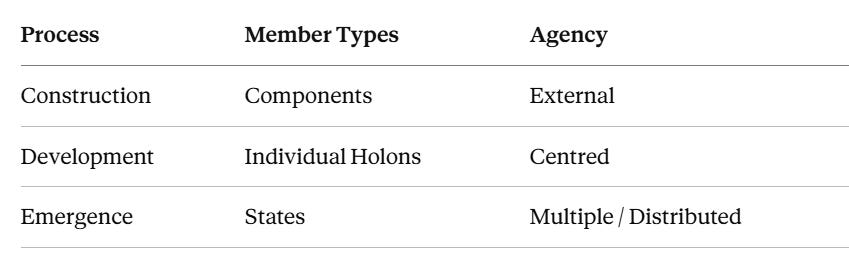
Three different kinds of change — not different speeds or scales of the same thing, but different in kind. This table is not a ranking, and emergence is not a higher form of development. They are different processes with different logics, and both occur in real organisations. The question is which one you are actually dealing with — and whether your intervention logic matches.
Application
Applying the wrong logic to the wrong phenomenon has predictable costs. Organisations invest in leadership development programmes expecting cultural transformation and most often get better-trained individuals who return to an unchanged field. They diagnose a team’s difficulties as a skills gap or a developmental problem — people somehow not yet mature enough in their thinking — when the actual obstacle may be a property of the field: the incentive structures, the informal hierarchies, the patterns of interaction that individual development alone will not shift. They apply frameworks that rank people and teams on a developmental hierarchy, which alters the relational dynamics in ways that actively work against the emergence they were hoping to support. And the conditions that would actually make a difference — the constraint changes, the shifts in who has voice, the alterations to what is safe to say — never get attended to, because the intervention logic is looking somewhere else entirely.
Development and developmental stage theory
The distinction between development as a generative process and developmental stage theory matters, and it deserves direct attention. Stage theory makes an additional claim beyond the observation that development happens: that it follows a universal sequence of hierarchical levels, and that higher levels represent more mature, more capable, more fully developed human beings. That additional claim is not required by the observation that development occurs. It is a separate argument — about universality, hierarchy, and adequacy — and it is the argument the second part of this article examines. What matters here is the assumption the two share: that the framework applies to individuals, and that when it is carried into collective and organisational contexts, specific and predictable errors follow.
What each logic implies
Developmental logic assumes there is a subject — a person — that is moving in a direction, integrating new capacities over time. It assumes you can identify that subject, work with it directly, and that the change happening is located inside it. A person learning to give difficult feedback, a manager developing the ability to hold complexity without rushing to a decision, a leader building the capacity to take multiple perspectives seriously: these are real examples where this logic fits. There is someone doing the developing, the work is located in them, and with the right support, challenge, and time, something genuinely changes.
Kurt Fischer’s research on dynamic skill development adds an important nuance here. Fischer showed empirically that cognitive and behavioural skills do not develop as stable, portable properties of a person. They develop in specific domains, under specific conditions, with specific support — and when that support is removed, measured performance drops, sometimes dramatically. Restore the conditions and performance recovers. What gets activated — when, at what level of complexity, in what context — is never solely a property of the person. It is also always a property of the situation and context. Dave Snowden captures this spot-on: “nature deals the cards, nurture plays them.”
Applying developmental logic to a group, a team, or an organisation is a category error. A group does not have a centre the way a person does. It is not a subject. It does not integrate external capacities into itself through an internal process. When a group changes, something different is happening: it reorganises. Patterns shift. New configurations become available, and old ones become less stable. This is emergence — and it requires a different kind of attention. A concrete comparison makes this visible. In developmental logic, if experienced members of a group leave, the group falls back to a lower developmental level. In emergence logic, the departure changes the field — the distribution of attention, tension, and affordance — and the system reorganises around the new configuration. That reorganisation is not inherently good or bad, and it can open new possibilities that were previously blocked. It can equally destabilise something that was working well. The point is that it moves laterally rather than up or down, and the direction is not specified in advance. Emergence has no built-in directionality. Development does.
Path dependency operates differently across the three process logics, and the distinction is worth making explicit. Dave Snowden points out that in developmental logic, path dependency is sequential and hierarchical: earlier stages are necessary preconditions for later ones, and the sequence cannot be reversed or skipped. The path is the point. In emergent logic, path dependency works more like ecological succession: pioneer species alter the substrate, making certain subsequent configurations possible without specifying which ones will stabilise. A pioneer birch forest does not develop toward beech woodland — it creates conditions under which beech woodland becomes available, among other possibilities. History matters and shapes what comes next, but it does not prescribe direction. Treating these as the same kind of constraint, as happens when developmental logic is applied to collective change, is itself a form of the category error described in the next section.
Where this creates problems at scale
Applying developmental logic to collective change does not produce a single error. It produces a cluster of distinct problems, each of a different kind, all rooted in the same underlying misapplication. What changes at the collective level is not the sum of individual changes. Something else shifts: the patterns of interaction, the informal rules about what can be said and to whom, the distribution of attention and trust across the system. These are not developmental achievements located in persons. They are emergent properties of the field, and they respond to different kinds of intervention.
Individual leadership development, coaching, communication skills training, decision-making programmes — these follow a developmental logic, and within their proper scope, they can work. A person practises a skill, receives feedback, integrates it over time, and genuinely becomes more capable. That is real and worth doing. But scaled organisational transformation almost always involves phenomena that are emergent rather than developmental: the appearance of new norms, the reorganisation of trust, the shift in what kinds of conversations become possible, the redistribution of informal authority. These are field effects. They arise from interactions, and not (sufficiently) from individuals' development.
And yet, in most large-scale transformation efforts, the intervention logic remains developmental. Consultants assess where people or teams sit on a maturity model. The organisation gets assigned to a stage — not yet agile, somewhere on the way to self-management, approaching whatever colour the current framework uses for enlightened collaboration. Programmes are then designed to move people forward along that sequence.
The problem is not the assessment tools or the programme design. The problem is that collective transformation is not a developmental phenomenon. It does not have a subject doing the integrating, a direction set in advance, or a locus you can work with directly. When developmental logic gets built into an intervention architecture for collective change, it becomes a design flaw. It produces three distinct problems, each of a different kind.
The first is a category error. Developmental logic locates the problem in individuals — their skills, their mindset, their level of maturity — when the actual obstacle may be a property of the relational field: the incentive structures, the informal hierarchies, the patterns of interaction. A category error does not arise from faulty reasoning within a framework. It arises from applying the framework to the wrong kind of thing. Without attending to field conditions, even genuine individual development may not transfer into collective change, because the phenomenon being addressed is not the phenomenon producing the difficulty.
The second is a structural fallacy. Developmental logic imports a directionality that collective change does not have, pushing people toward a predetermined destination rather than attending to what the system is actually producing. The fallacy is structural because the assumption of directionality is not an incidental mistake — it is built into the method and does inferential work throughout. It generates conclusions that would not follow without it. Stage theory assumes that the destination — the more self-authoring culture, the more complex organisation — already exists as a stable attractor, and that the task is to move toward it. In Dave Snowden’s change trialectic, this is a named failure mode: assuming the destination already exists as a stable configuration the system can move toward, when in fact no such configuration exists yet. The organisation that drives toward a vision of transformation with transitional energy typically destroys the existing attractor without creating the new one.

This is also what makes developmental narratives of organisational change structurally resistant to disconfirmation or self-correction. After the fact, you can almost always construct a developmental story about what happened — the organisation matured, the culture evolved, the leadership grew into greater complexity. The story feels coherent because developmental narratives are familiar and satisfying, and because the frame selects the evidence that fits it. But retrospective coherence is not an explanation. The actual drivers of change — shifts in who was in the room, what constraints changed, what tensions became productive or were resolved — are emergent dynamics. They do not show up in a developmental account because the developmental frame is not looking for them. A framework that can absorb any outcome as evidence of its own sequence does not describe the phenomenon, but narrates it.
The third is a performative contradiction. Developmental ranking does not simply misdescribe the system; the problem is that it changes it. Once people know, or sense, that they are being assessed against a developmental hierarchy, the relational field reorganises around that knowledge. What becomes sayable changes, and who defers to whom shifts. People position themselves and each other within a model they did not construct and may not share. The instrument meant to describe the field has altered the field it was meant to describe. And because the alteration moves in the direction of greater hierarchy and greater caution about self-exposure, it works directly against the conditions under which emergence becomes possible — the distributed voice, the lateral trust, the willingness to surface what is actually happening rather than what the model expects. Bonnitta Roy states this directly: you cannot work directly toward what you want to emerge. You can only work on the conditions — the rituals, protocols, the constraints, the quality of interaction — such that if you get those right, something emerges. The outcome is not available as a target. It is only available as a result. Dave Snowden makes the same point from a different angle: “It is a lot easier to achieve change if the system is predisposed to change. If the energy cost of virtue is lower than that of sin, then virtue is more likely.”
What comes next
The argument so far has been critical of what happens when developmental logic is applied to collective change. It has not yet addressed the harder questions: whether the patterns that developmental stage theory describes are themselves correctly understood as stages; whether the instruments built to operationalise that framework are doing what they claim to do; and whether a different kind of instrument, built on different assumptions about where capacity resides, could surface those patterns more honestly. Those are the arguments of the second part.
Part Two: Modulators, Not Stages
The three problems described in the first part of this article — the category error, the structural fallacy, the performative contradiction — all follow from a prior assumption: that what Robert Kegan and other researchers observed are stages. Stages imply a subject doing the climbing, a universal sequence with a direction, and a hierarchy of adequacy. Strip those implications away, and the problems largely dissolve. But that requires asking a prior question: are they actually stages, or is that the wrong description of what Kegan found?

The reframing proposed in what follows comes from inside the Cynefin tradition and carries that tradition’s assumptions. It is offered not as a replacement framework but as a genuinely different way of holding what the developmental research has found — one that the author believes is more honest about what those findings actually show, while acknowledging that the argument is not yet settled.
Something in these frameworks keeps attracting serious practitioners, and the attraction is not misplaced. The descriptions of what Kegan calls the adult development stages, socialised, self-authoring, and self-transforming mind, are not arbitrary. They capture something real about how people organise meaning, relate to authority, and handle the tension between their own judgement and the expectations of the systems they inhabit. The question is not whether these patterns exist — they are recognisable in real leadership interactions — but what kind of thing they are.
Not all theorists make the stage claim with equal force. Robert Kegan’s framework carries it most explicitly. In In Over Our Heads: The Mental Demands of Modern Life (Harvard University Press, 1994), he argues that modern life — its institutions, its relationships, its professional demands — makes psychological demands that a majority of adults’ current order of consciousness is not adequate to meet. The hierarchical adequacy claim is built into the book’s structure: the self-authoring mind is more adequate to the demands of modern life than the socialised mind, and the self-transforming mind more adequate still. Kurt Fischer’s dynamic skill theory is more cautious — Fischer’s empirical concern is with how skills develop in specific domains under specific conditions and contexts, and his framework resists the portable, universal maturity reading. Theo Dawson’s Lectica framework is more careful still, focusing on demonstrated reasoning complexity rather than developmental level as a stable property of the person. These are not the same claim, and the problems that follow from the normative framing apply with different force to each.
There is also a longer history behind the normative claim worth noting. David Graeber and David Wengrow have shown at the scale of human social history that the impulse to arrange social forms on a developmental ladder has been persistently and consequentially wrong about the actual diversity and reversibility of human organisation. The organisational version of that impulse inherits the same structure.
The concept that does the reframing work here is one Dave Snowden proposes: treat Kegan’s configurations not as stages on a hierarchy but as modulators. A modulator is not a stage or a level. It is a condition that shifts what configurations are available in a field — not by specifying what will emerge, but by making certain patterns more or less accessible. The image Snowden uses to clarify this is simple: place magnets under a table and iron filings on top. The magnets do not touch the filings directly. They do not instruct them or develop them. They alter the field, and the filings settle into patterns that the field makes available. Change the position, strength, or polarity of the magnets and the patterns on the surface shift, but not because the filings have been moved individually, but because the conditions have changed. What Kegan describes as stages may be better understood as modulators in this sense: not positions on a ladder that individuals climb, but field conditions that make certain patterns of meaning-making more or less available to a system depending on context and constraint.
The socialised configuration, the self-authoring configuration, the more fluid meta-perspectival pattern — these present as a sequence, and serious researchers, including Dawson and Cook-Greuter, have empirical data showing that the patterns do appear in a broadly consistent order. That evidence is not to be dismissed. What is less settled is whether the sequential appearance requires a rung explanation — whether there is a developing subject climbing a universal ladder — or whether it is better accounted for by the social and neurological conditions under which these patterns become available. Kurt Fischer’s own research complicates the rung picture from within: his distinction between optimal and functional performance levels shows that the same person operates across a significant range depending on context and support, and that development proceeds through spurts and regressions rather than stable sequential steps. That pattern is more consistent with attractor dynamics than with ladder climbing. Recent neuroscience of adult brain plasticity and evolutionary biology of human social organisation point in the same direction: that what looks like a rung may be a stable attractor region, shaped by social interaction, context, and the specific plasticity windows of neurological development rather than by a universal developmental sequence.
The child development literature that grounds Kegan’s framework is not in question. Genuine sequential stages in cognitive and moral development — object permanence before abstract reasoning, concrete operations before formal ones — are well documented and track neurological development in ways that are reasonably universal.
The problem, as Snowden identifies it, is the extrapolation: adult meaning-making does not have the same neurological substrate. The structural brain changes that underpin child development are not happening in adults in the same way. What changes in adults, when they change, is better understood as a shift in which patterns are available under which conditions than as movement through fixed stages toward a terminus.
There is a further epistemological problem. Kegan’s higher configurations — self-authoring and self-transforming — map with considerable precision onto a specific cultural formation: individualist, oriented toward interiority and autonomous judgement as the markers of maturity. A stage that is not universal cannot anchor a hierarchy of adequacy. If what Kegan describes as self-authoring is an endpoint in one cultural formation and a form of relational failure in another — where identity is constituted through connection rather than individuation — then the sequence is not describing human development as such. It is describing one tradition’s account of what a mature person looks like, presented as universal. As Snowden argues, this is not primarily an ethical objection, though the ethical implications are real. It is an epistemological one. Dave Snowden is developing that argument in full, drawing on this evidence base, and it will be published separately. The modulator reframing proposed here is consistent with that account: not a refutation of what Dawson and others observe, but a different explanation of what produces it.
These are attractor regions that a field can stabilise around, move away from, or oscillate between. The question for practice is not which rung someone has reached. It is which modulators are currently active in the field, what they are making available, and what would shift the distribution. What this means practically is a shift in the questions worth asking. Instead of: what stage is this leader at, the question becomes: what patterns of meaning-making are currently being stabilised in this field, and under what conditions? A socialised configuration — in which a person organises their judgement around the expectations of the relational system they inhabit — is not a sign of immaturity. It may be exactly what a particular ecology is producing under its current constraints. A self-authoring configuration — in which a person acts from an internally held value system capable of withstanding external pressure — may be adaptive in one context and actively disruptive in another. A more fluid pattern may be generative under conditions of genuine complexity and actively destabilising when what the system needs is coherence and direction. None of these is generically better. All of them are real. And crucially, as Fischer’s research established, the same person will show different patterns under different conditions. What looks like a stable trait is always partly a property of the field.

Description, Not Evaluation
The most careful developmental assessment instruments — Cook-Greuter’s Sentence Completion Test and Dawson’s Lectical Assessment — are not peer evaluations. They ask the person themselves to respond to prompts, and a trained scorer analyses the structural complexity of those responses. No one is asked to rate anyone else. That design has a specific rigour: what is being measured is a property of the person’s own reasoning, not a filtered opinion about them.
The 360-degree feedback instrument operates on an entirely different logic, and it is worth being clear that it has left the scientific register of developmental assessment behind. It became standard practice in organisational development for a reason: individual self-assessment is insufficient, coach or interviewer assessment is not scalable and concentrates interpretive authority in the expert, and organisations genuinely need multiple perspectives on how a leader operates in real interactions. The 360 was a pragmatic attempt to meet that need, and, understandably, it spread.
The problem is that it answers the right question with the wrong instrument. The right question is: how does this leader actually function in real interactions, as experienced by the people around them? The 360 asks people to rate a person against a competency model rather than describe what actually happened in real interactions. What comes back is not an account of how the leader functions in practice. It is a set of evaluative judgements, filtered through the evaluators' own positions, relationships, and the assumptions built into the framework. This is why Dave Snowden's principle — never ask someone to evaluate another human being — is not merely methodological caution. It is an observation about what evaluation does to a relational system.
There is a further problem that rarely gets named: Evaluation instruments measure the evaluator as much as the evaluated. What someone says about another person’s capability or maturity is always also a description of their own relationship to authority, their own cultural formation, their own position in the relational field. Standard instruments treat this as noise and try to average it out. A well-designed narrative capture treats it as signal — because the way someone describes an interaction they were part of is never only about the other person. It is about the whole relational configuration, including the narrator’s own position within it.
And there is Goodhart’s Law: when a measure becomes a target, it ceases to be a good measure. Once the developmental vocabulary circulates in the organisation — once people know they are being assessed on self-authoring or self-transforming dimensions — they begin performing toward it. People begin performing toward the criteria. The instrument then measures the performance of the method rather than the phenomenon the method was designed to describe.
The coaching and leadership development industry has built an enormous infrastructure on instruments that are, in this precise sense, self-undermining. The more widely they are used, the less accurately they measure what they claim to measure.
Kegan’s Subject-Object Interview — the most careful instrument his framework produced — avoids some of these problems but introduces others. It requires hours of trained interviewer time per person, is not administrable at an organisational scale, and the interview process itself privileges the interviewer as the expert holder of the source data. What gets deployed in its place are the simplified self-report instruments described above. The gap between the rigour of the original method and what actually runs in organisations is not an implementation problem. It is structural.
What a better instrument would need to do is meet the 360’s original ambition — multiple perspectives on real interactions, at scale — without asking anyone to evaluate anyone, without naming what it is looking for, and without producing a measure that immediately becomes a target. That is precisely what SenseMaker’s micro-narrative approach is designed to provide.

The patterns are properties of the field, not of the individuals in it. They can shift — certain people, certain crises, certain changes to the constraint landscape can move them — but not through individual development alone. The intervention is not aimed at the person. It is aimed at the conditions under which certain patterns of meaning-making become more or less available to the system as a whole.
A Different Approach
Dave Snowden offers a distinction that is useful here, though it comes from inside his own framework and should be read as such: most developmental stage instruments rest on what he calls the assumed deficit model: the practitioner arrives with the premise that the system lacks something — a higher developmental stage, a more adequate order of consciousness — and their role is to supply the diagnosis, the programme, and the path toward it. The model requires a deficit in order to function. Without something to supply, there is no role for the intermediary.
SenseMaker operates on a different premise — what Snowden calls the innate capacity model. The capacity for the patterns Kegan describes is already present in the field. The practitioner's role is not to supply what is absent but to create conditions under which what is already there can become operative. That is wayshaping rather than supplying, and it requires a different instrument.
An instrument that meets those criteria would need to work on different principles entirely. It would need to capture how people actually experience real interactions — from multiple positions simultaneously — without asking anyone to evaluate anyone. It would need to surface patterns of meaning-making without naming what it is looking for.
And it would need to return interpretation to the participants themselves rather than concentrating it in an expert analyst. SenseMaker’s micro-narrative approach is built on exactly those principles.
Participants — leaders, peers, co-workers — are invited to describe a specific, concrete interaction that mattered: a moment of decision, tension, disagreement, or uncertainty, in their own words. The prompt carries no hypothesis, no developmental vocabulary, no competency framework, and no invitation to position themselves or anyone else on a scale of maturity or effectiveness. It asks only for a situated account of something that actually happened, in enough detail that the person telling it can locate themselves in it.
They then signify that story — locating it within a set of interpretive frameworks of their own choosing — through carefully designed triads and dyads. A triad presents three interpretive poles arranged as a triangle, allowing the narrator to place their story anywhere in the space between them rather than selecting a single answer; a dyad presents two poles as a scale. None of the signifiers — the constructs the triads and dyads present — name a stage or invite self-assessment against a developmental criterion. The signifiers are designed to be genuinely ambiguous between the attractor patterns — not obviously pointing toward a more or less developed position — so that what gets surfaced is the actual texture of the experience rather than the participant’s preferred self-presentation.
The Mirror
The story provides the situated context. The signification reveals the activation pattern within it. And because both the leader and the people they interact with describe the same interaction from their own position, what emerges is not a verdict on any individual but a map of the relational field as it was actually experienced from multiple positions simultaneously. The gap between how the leader experienced and signified the interaction and how others experienced and signified the same event is itself the data — and often the most revealing data in the whole capture. What the resulting “landscape of small noticings” produces is not a developmental profile of individuals but a picture of the field — built from self-signified descriptive micro-narratives of real interactions, returned to the participants as a collective pattern rather than interpreted by an expert. The practitioner working with this data is not asking who needs to develop. They are asking what conditions are currently shaping the field, and what changes to those conditions might make different patterns more available. That is a different theory of change. The intervention is not aimed at the person. It is aimed at the constraint landscape — the conditions under which certain patterns of meaning-making become more or less available to the system as a whole. The practitioner is not supplying what is absent. They are modulating conditions so that what the system is already capable of becomes more accessible.
What This Preserves and What It Releases
This approach preserves what is phenomenologically real in Kegan’s observations. The patterns he describes — the socialised, self-authoring, and self-transforming configurations — are recognisable in real leadership interactions, and practitioners are right to find them useful. What it releases is the hierarchical and teleological framework that surrounds them: the claim that these are universal stages, that higher is better, that the endpoint is knowable in advance, and that the practitioner’s role is to move people up the sequence.
The instrument changes accordingly. Where evaluative instruments produce a label — this person is at this level, this organisation has reached this stage — a field-based instrument functions as a mirror. It returns a picture of the patterns currently active in the system, seen from multiple positions simultaneously, without pronouncing on their adequacy. The practitioner works with what the mirror shows, not against a model of what it should show.
The configurations become markers — descriptions of attractor patterns that a system can move toward or away from, depending on field conditions and contexts — rather than destinations on a developmental ladder. The question is never which stage this person has reached. It is which patterns are currently active, what is producing them, and what would shift the distribution. Configurations without inherent hierarchy have no universal destination. What is available in a field depends on the conditions of that field — not on a universal developmental sequence that every human being is moving along, whether they know it or not. That is not a relativist claim. It is a more accurate account of what the evidence actually shows. That is a more honest account of what these frameworks actually observe — and a more useful basis for intervention.
Three Design Problems Worth Taking Seriously
Proposing SenseMaker as an alternative to developmental stage instruments is not a simple substitution. Dave Snowden, who has thought carefully about both the modulator reframing and the design constraints of SenseMaker, identifies three problems that any serious implementation would have to address.
The first is the triad design problem. If Kegan’s forms of mind are being recast as modulators rather than stages, the triads need to distinguish activation patterns rather than developmental levels. But Kegan’s original descriptors carry evaluative grammar — self-sovereign sounds lower, self-transforming sounds higher — and stripping that grammar from the signifiers without rendering them unrecognisable is a genuine design challenge. This is compounded by SenseMaker’s core logic: interpretation is not performed by an analyst but returned to the respondents themselves. The output functions as a mirror — respondents see their own collective pattern in the signification and draw their own sense from it. There is no expert standing between the data and its meaning. The design implication is that the signifiers need to be genuinely oblique to the attractor patterns they are designed to surface — not in order to hide something from an analyst, but because the respondents themselves will encounter the output directly. If the signifiers are recognisable as developmental categories, the mirror shows people a ranking rather than a pattern. The design challenge is to make the signifiers experientially precise without being theoretically legible as a stage framework.
The second is what might be called the subject-object objection. Stage theorists will argue, not unreasonably, that SenseMaker captures how people make sense of their experience in context — and that Kegan’s work is specifically about the structure of subject-object relationships, which is not the same thing. What a person can take as object and what they remain subject to is a structural feature of their meaning-making, not simply a feature of how they narrate a situation. The response to this objection is that the narrative itself carries subject-object information. Where a person locates agency, causation, and constraint in their story — what they can see and name and stand back from, and what remains invisible or taken for granted — is precisely the subject-object structure made legible. The triad does not measure that structure directly, but the story does. Together, they triangulate something closer to what Kegan is describing than any self-report instrument achieves. SenseMaker is capturing proxies, expressions, and correlates — and that needs to be stated honestly rather than overclaimed.
The third is the intervention design problem. SenseMaker generates a landscape built from self-signified descriptive micro-narratives of real interactions — small noticings, returned to the participants as a collective pattern rather than interpreted by an expert. The move from that distribution of modulator activation patterns to a concrete next step for the practitioner requires a theory of wayshaping — of how to work with a field rather than on individuals. This is where Estuarine Mapping becomes the relevant instrument: not as a diagnostic tool but as a method for working with the constraint landscape that the SenseMaker data reveals. The practitioners are modulating conditions — shifting what the field makes available — using the logic of more like these, fewer like those that is already embedded in SenseMaker’s intervention design. These three problems are not objections to the approach. They are the design criteria. The case made here for SenseMaker as an alternative instrument rests on conceptual grounds, not yet on empirical comparison with the instruments it critiques. That comparison remains to be done. The practical instrument — the triad and dyad architecture, the story prompts, the output framework — is being developed as a separate working document. What the present article has argued is that the reframing is both necessary and theoretically sound. The design work is the next step.
An Open Question
The argument made here is critical, but the intent is not to discard what Kegan, Fischer, and Dawson found. The patterns Kegan describes are real. Dawson’s methods for scoring the complexity of reasoning demonstrated in text are among the most rigorous instruments developmental research has produced — precisely because they analyse what a person actually does with an idea, not what they report about themselves. None of that work is being rejected. The question is whether it can be used differently.
What SenseMaker and Lectica measure are genuinely different things. A SenseMaker capture produces a picture of the field— the distribution of meaning-making patterns across a population of narrators, surfaced through story and oblique signification, without naming what it is looking for. Dawson’s LDMA and LRJA methods produce a complexity profile of an individual’s reasoning, as demonstrated in text, of what the person can actually do with abstraction when asked to work through something that matters to them. One instrument reduces to the field, the other reduces to the person. That structural difference could be made productive.
The proposal here is simple: run both on the same material. A SenseMaker capture produces narratives — situated accounts of real interactions, told in the narrator’s own words. Those narratives are also text. There is no technical reason why the same narrative that feeds a SenseMaker signification could not also be scored through Dawson’s methods. The two analyses would then sit alongside each other, describing the same event from two different analytical positions.
What would be interesting is not where they converge but where they diverge. A person whose narrative scores at high complexity on Lectica’s scale but whose signification places them firmly in a socialised activation pattern is telling you something that neither instrument alone could tell you: that demonstrated reasoning complexity and the relational field in which that reasoning is actually deployed are not the same thing, and do not always move together. The divergence between a Lectica score and a SenseMaker signification pattern would make that difference visible and specific, rather than leaving it as a theoretical claim.
This is a design hypothesis, not a validated method, and there are genuine methodological questions to be resolved before it could be. SenseMaker prompts typically produce shorter, more situated narratives than the extended reasoning texts Lectica scoring is calibrated for — whether they are rich enough for reliable complexity scoring is a question Dawson and her colleagues would need to assess. The signifier architecture would need to be designed with the comparison explicitly in mind. Lectica’s software-assisted scoring module changes the scalability picture considerably: what was previously limited by the time demands of trained human scoring can now be run across a larger corpus of narratives, which makes the parallel analysis practically feasible rather than merely theoretically interesting. None of that is insurmountable, but it is real work.
The invitation is to that work. If what Kegan observed are not stages on a universal developmental ladder but recurring patterns in a relational field — configurations that the same person can move toward or away from depending on context and constraint — then the most interesting research question is not which stage someone has reached but how demonstrated reasoning complexity and relational activation pattern relate to each other across different contexts and conditions. That question cannot be answered by either instrument alone but might be answerable by both.
This article sits within a broader conversation in progress. Dave Snowden’s trialectics series — developing the philosophical and methodological grounding for much of the framework used here — is running in parallel at thecynefin.co. The introductory post on trialectics, the post on the change trialectic (Perturbate · Transit · Transform), and the post on a trialectic for organisational practice and coaching are directly relevant to the argument made here and should be read alongside it.
References
Cook-Greuter, Susanne. Sentence Completion Test.
Dawson, Theo. Lectica; LDMA (Lectical Decision-Making Assessment); LRJA (Lectical Reflective Judgment Assessment).
Fischer, Kurt. Dynamic skill theory.
Graeber, David, and David Wengrow. The Dawn of Everything. Allen Lane, 2021.
Juarrero, Alicia. Dynamics in Action. MIT Press, 1999.
Kegan, Robert. The Evolving Self. Harvard University Press, 1982.
Kegan, Robert. In Over Our Heads: The Mental Demands of Modern Life. Harvard University Press, 1994.
Roy, Bonnitta. Generative process typology.
Snowden, Dave. Writings on Cynefin, enabling constraints, and anthro-complexity.
Snowden, Dave. "Trialectics, or Thinking in Threes." thecynefin.co, 6 May 2026.
Snowden, Dave. "Neither Repair nor Revolution." thecynefin.co, 10 May 2026.
Snowden, Dave. "A Trialectic for Organisational Practice & Coaching." thecynefin.co, 31 May 2026.
Pictures by the author.
I am a complexity coach and leadership trainer, have worked for the last decade with the team from The Cynefin Company and before that had intensive exposure to Integral and Developmental Stage Theory since 2005. I am certified in LDMA Lectical Assessment and a buch of other methods, including 360. More here: www.complexitypartners.com

Comments